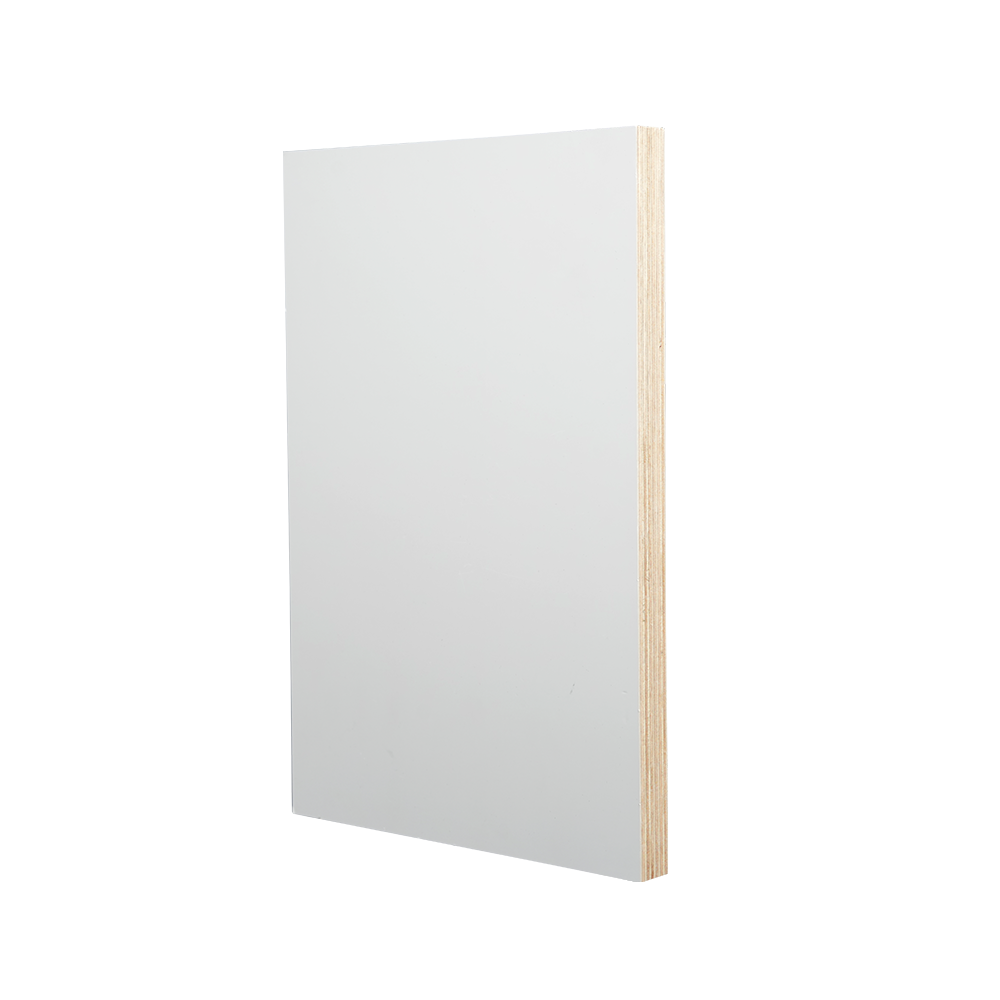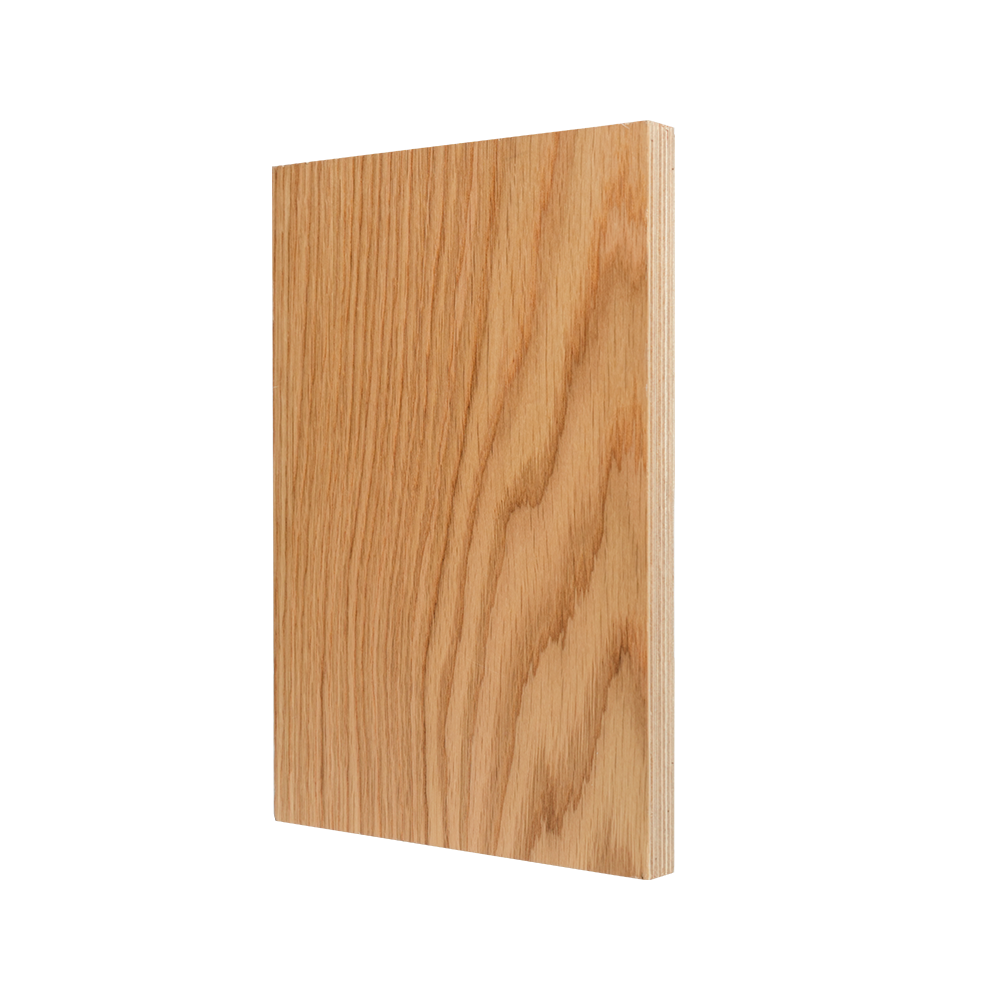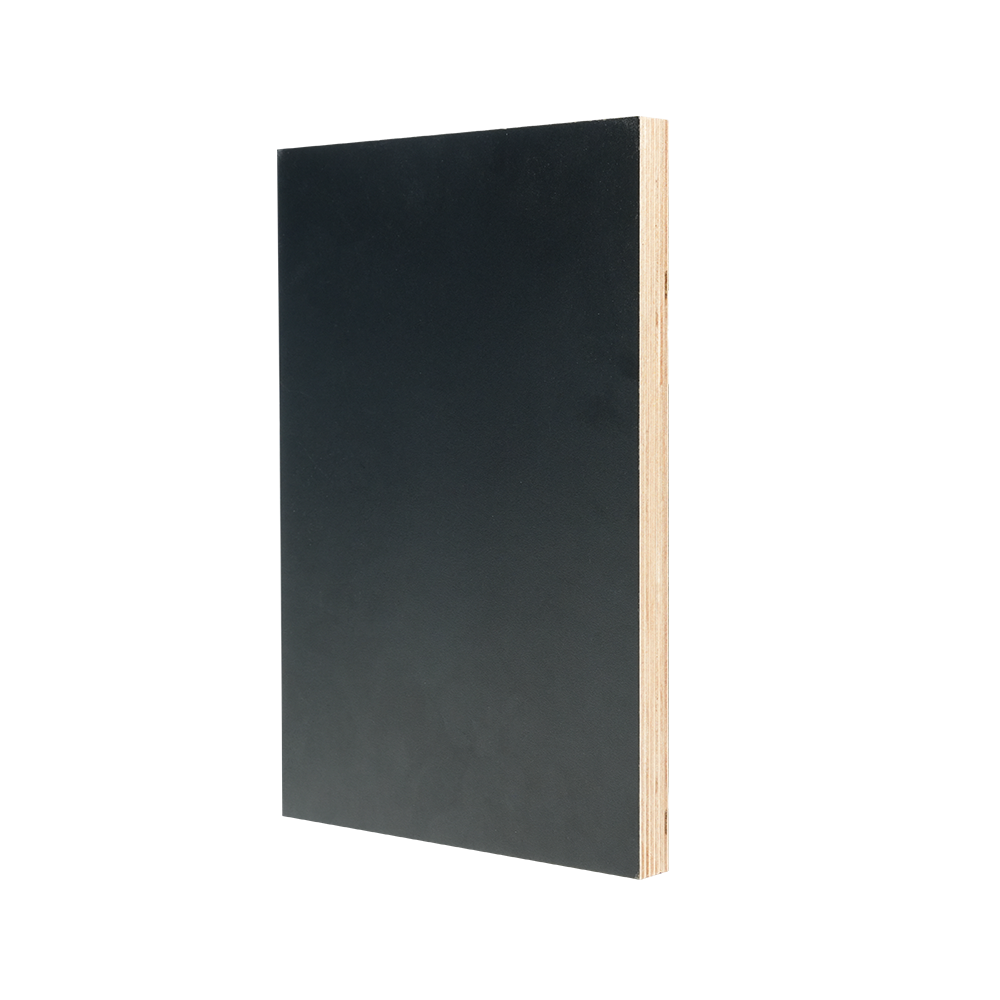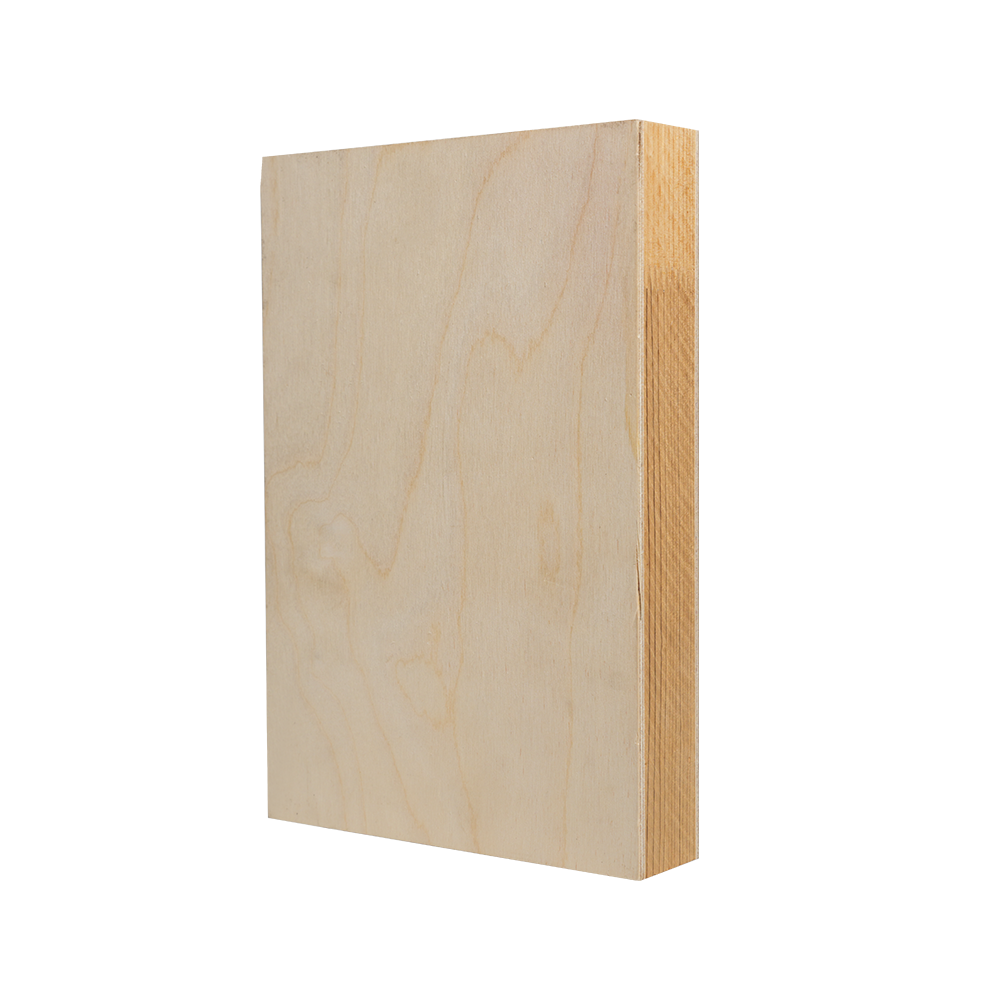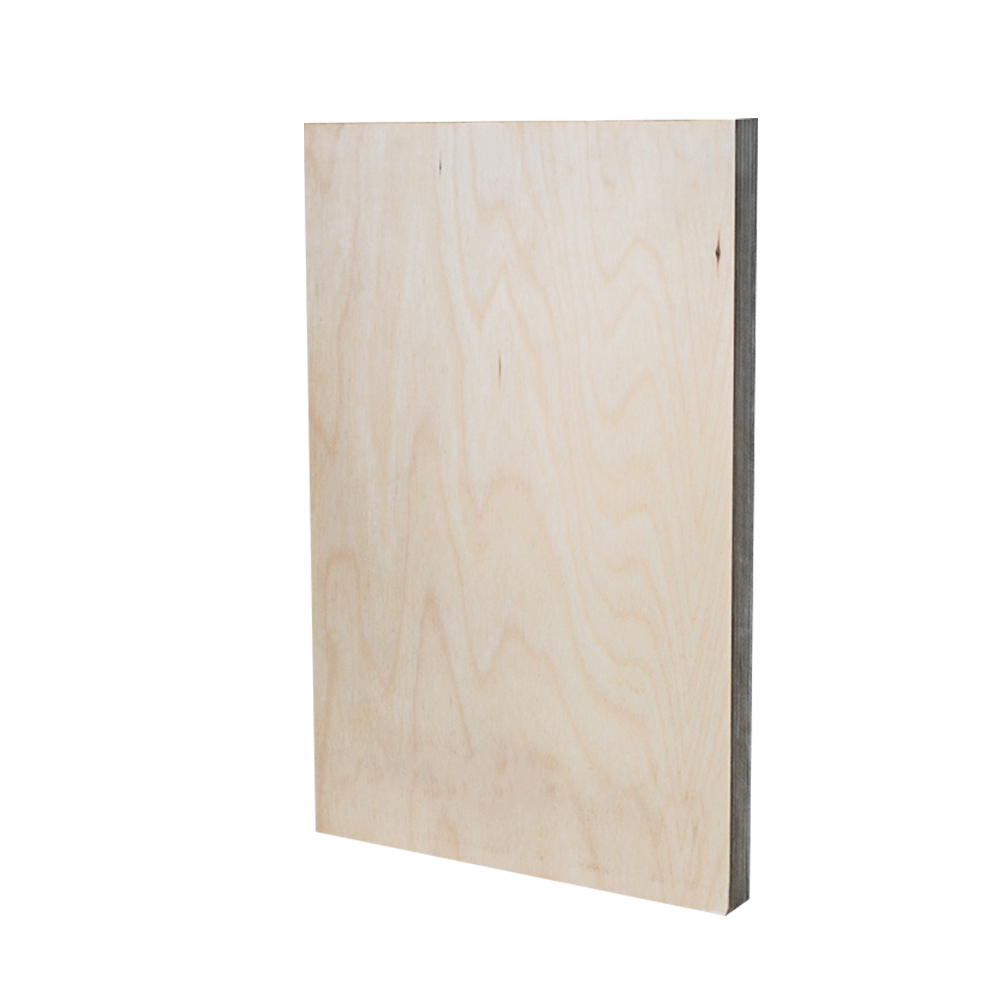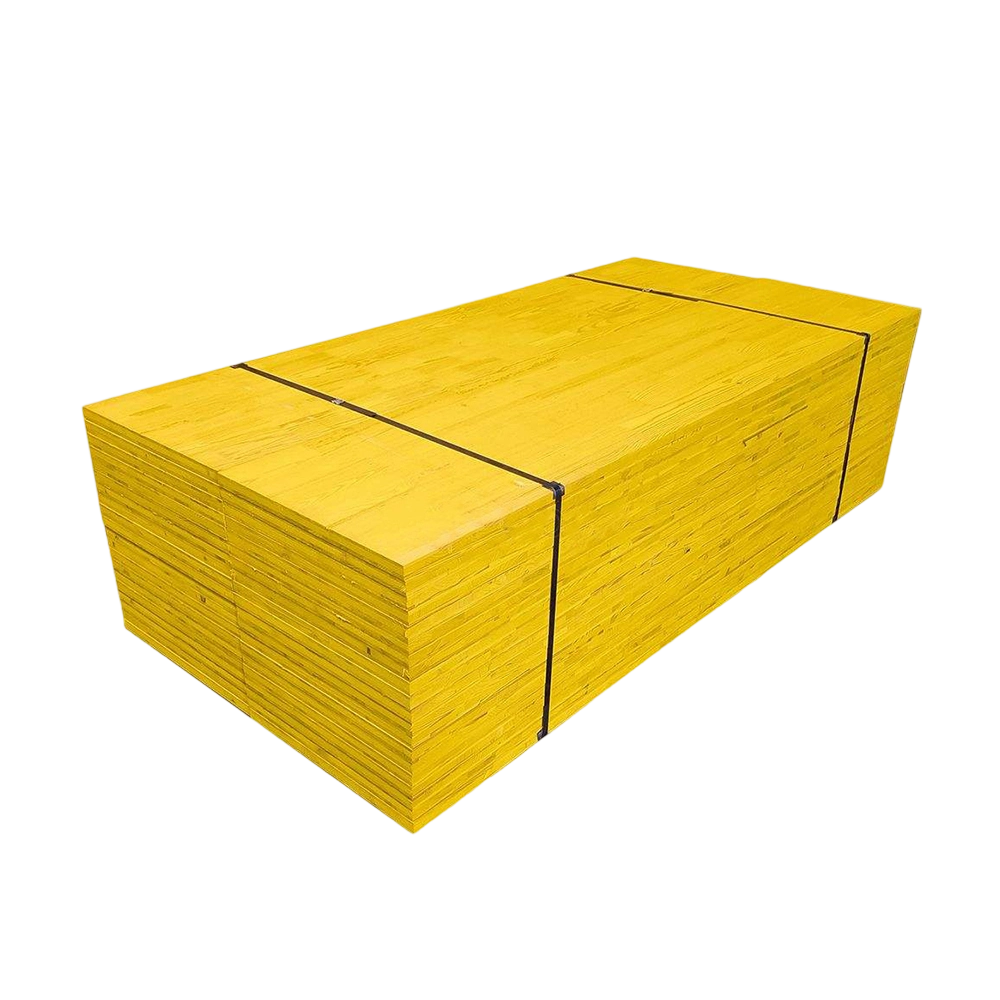

When a designer, cabinetmaker, or contractor asks whether oak or birch plywood is stronger, the practical answer is birch — at equal thickness, and when the birch panel is genuine full-birch construction. Solid oak is undeniably a hard, dense wood. But oak plywood sold for furniture, interiors, and general construction is usually a thin oak face veneer over a low-density core of poplar, pine, or mixed wood. Full-birch plywood, in contrast, is built from birch veneers in every layer: face, back, and core. That one difference changes almost every structural property that matters in a panel.
In representative 18 mm panels, full-birch plywood reaches a modulus of elasticity of roughly 12,000 N/mm² and a modulus of rupture near 75 N/mm². An oak-faced panel with a softwood core typically sits around 6,800 N/mm² for elasticity and 42 N/mm² for rupture. These are not cosmetic differences. A shelving bay can be spaced wider, a workbench top deflects noticeably less under load, and a concrete formwork panel can be stripped, cleaned, and reused more times before its edges break down.
The answer also needs one qualification: "oak plywood" is not a single product. If the oak-faced panel has a birch or another hardwood core, its strength approaches full-birch levels. The correct comparison is therefore not oak as a species against birch as a species, but oak-faced construction against full-birch construction. Everything below explains why that comparison produces such different numbers, and how to verify which panel you are actually buying.
A plywood panel is an engineered composite. It resists bending and distributes load because each veneer is cross-laminated at roughly 90 degrees to the one below it, and the whole stack is bonded under heat and pressure. The species printed on the datasheet matters far less than the structure behind it. Four factors determine what a panel can actually support:
Consider a simple shelf. A 1,000 mm span made from 18 mm full-birch plywood deflects noticeably less than a panel built with a poplar core, and it returns to its original position when the load is removed. The birch panel also continues to carry load if a concentrated weight sits near the centre, because the dense veneers distribute the force across multiple plies before the adhesive line is stressed. This is why the same panel construction that serves cabinet carcasses can also be used for scaffolding boards or truck flooring, while decorative oak-faced panels cannot.
Before comparing test data, clarify the label. Oak plywood in the market usually falls into one of four constructions:
| Panel type | Typical core | Oak face thickness | Relative bending strength |
|---|---|---|---|
| Oak-faced decorative panel | Poplar or pine core | 0.4-0.6 mm | About 55-70% of full birch |
| Oak-faced hardwood-core panel | Birch or mixed hardwood core | 0.5-0.6 mm | About 85-95% of full birch |
| Oak-faced MDF-core panel | Medium-density fibreboard | 0.4-0.6 mm | About 40-60% of full birch |
| Full-birch plywood | Birch throughout | Birch face, not oak | Reference value, 100% |
The softwood-core and MDF-core versions are the ones most commonly compared with birch plywood because they dominate retail furniture and interior decoration. Their oak face is there for appearance, not structure. The hardwood-core version is a legitimate structural panel, but in that case the core — not the oak face — is doing nearly all of the work.
The table below summarises representative measured values for 18 mm panels. Values come from typical EN 636, EN 789, and GB/T 17657 test reports and can vary slightly by manufacturer, veneer quality, and adhesive. Use them as planning figures, not as a substitute for the supplier's test certificate.
| Property | Full-birch plywood | Oak-faced softwood-core plywood | Solid white oak board |
|---|---|---|---|
| Average density (kg/m³) | 680 | 490 | 750 |
| Modulus of elasticity, MOE (N/mm²) | 12,000 | 6,800 | 12,300 |
| Modulus of rupture, MOR (N/mm²) | 75 | 42 | 100 |
| Face screw withdrawal (N) | 1,150 | 700 | 1,000 |
| Edge screw holding, 18 mm edge (N) | 780 | 430 | 720 |
The two charts below visualise the most important structural comparisons from the table. All values are normalised to the strongest material in each chart.
Modulus of elasticity (stiffness), N/mm²
Modulus of rupture (bending strength), N/mm²
Two observations stand out. First, an oak-faced softwood-core panel is about 45% less stiff and roughly 44% weaker in bending than full-birch plywood at the same thickness. Second, solid white oak remains slightly stiffer than birch plywood, but the comparison that matters for panels is plywood against plywood. If you want true oak strength in a sheet product, the panel needs a hardwood core, not just an oak face.
Test numbers matter only when they translate into predictable behaviour on site or in the workshop. Here is what the differences above mean for everyday use.
MOE controls deflection. On a 900 mm shelf span, an 18 mm birch plywood shelf bends roughly 40-45% less than an oak-faced softwood-core shelf carrying the same load. For wardrobe shelving, bookcases, and worktops, that translates to either wider spans or fewer centre supports.
MOR controls failure load. A panel that reaches 75 N/mm² rather than 42 N/mm² resists roughly 80% more bending load before fracture. This is the metric to watch for concrete formwork, staging, storage platforms, and any application where overload is possible.
Fastener retention decides how long furniture lasts. Hinges, drawer slides, and frame joints live or die by edge screw holding. Full-birch plywood typically holds 60-80% more screw pull-out force than softwood-core oak-faced panels, and its dense surface resists denting from tool drops, trolleys, and daily use.
There is also a practical strength-to-weight advantage. Full-birch plywood at 680 kg/m³ is lighter per square metre than solid oak, yet its stiffness per kilogram is higher than that of any softwood-core panel. Combined with dimensional stability from cross-banding, this weight factor matters in prefabricated sections that are lifted manually, in cabinet doors that must stay flat over large surfaces, and in material handling where panel weight directly affects installation cost.
If you are specifying for a structural or semi-structural application, check the panel's MOE and MOR rather than relying on the face species label. A high MOE keeps the panel flat under load; a high MOR protects against sudden brittle failure. Both are far more predictable in full-birch construction than in decorative oak-faced panels. For a side-by-side review of where these advantages appear, see the technical advantages of birch plywood in strength and hardness compared with other plywoods.
The practical benefits of birch plywood are easiest to see in specific, everyday applications:
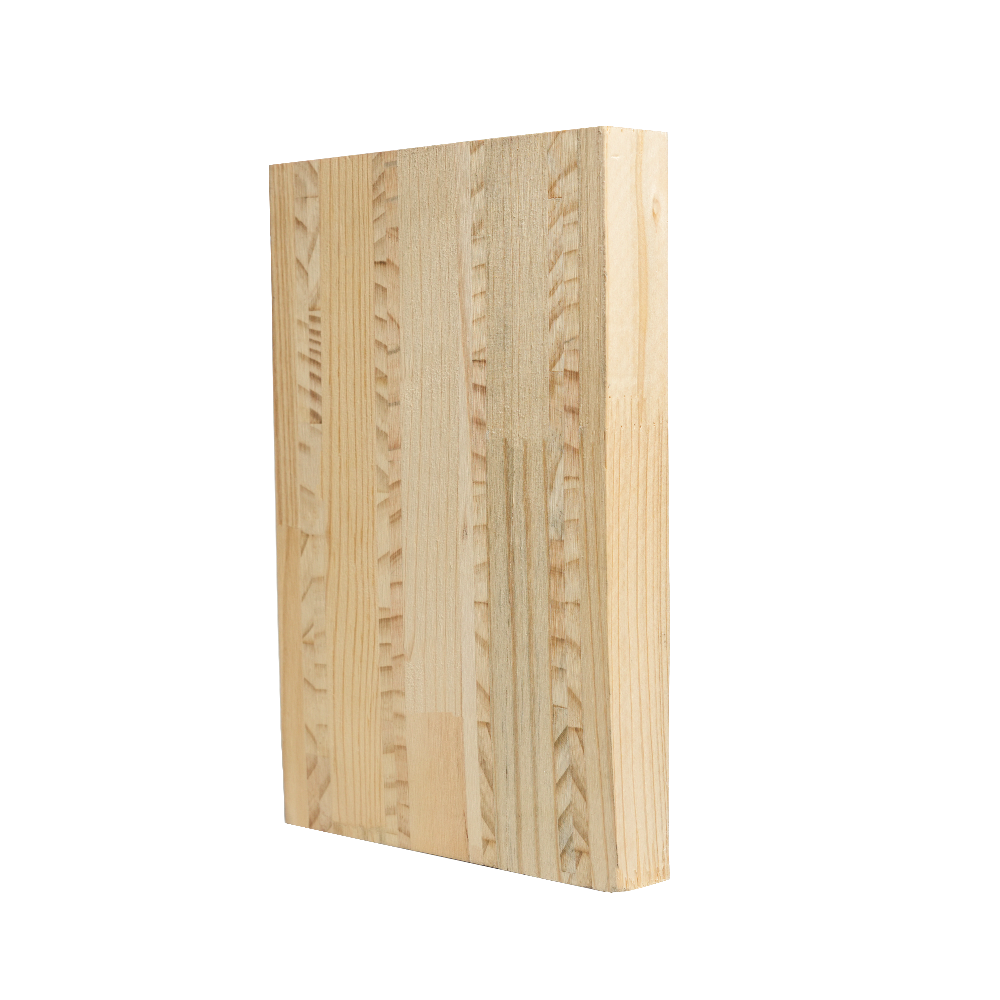
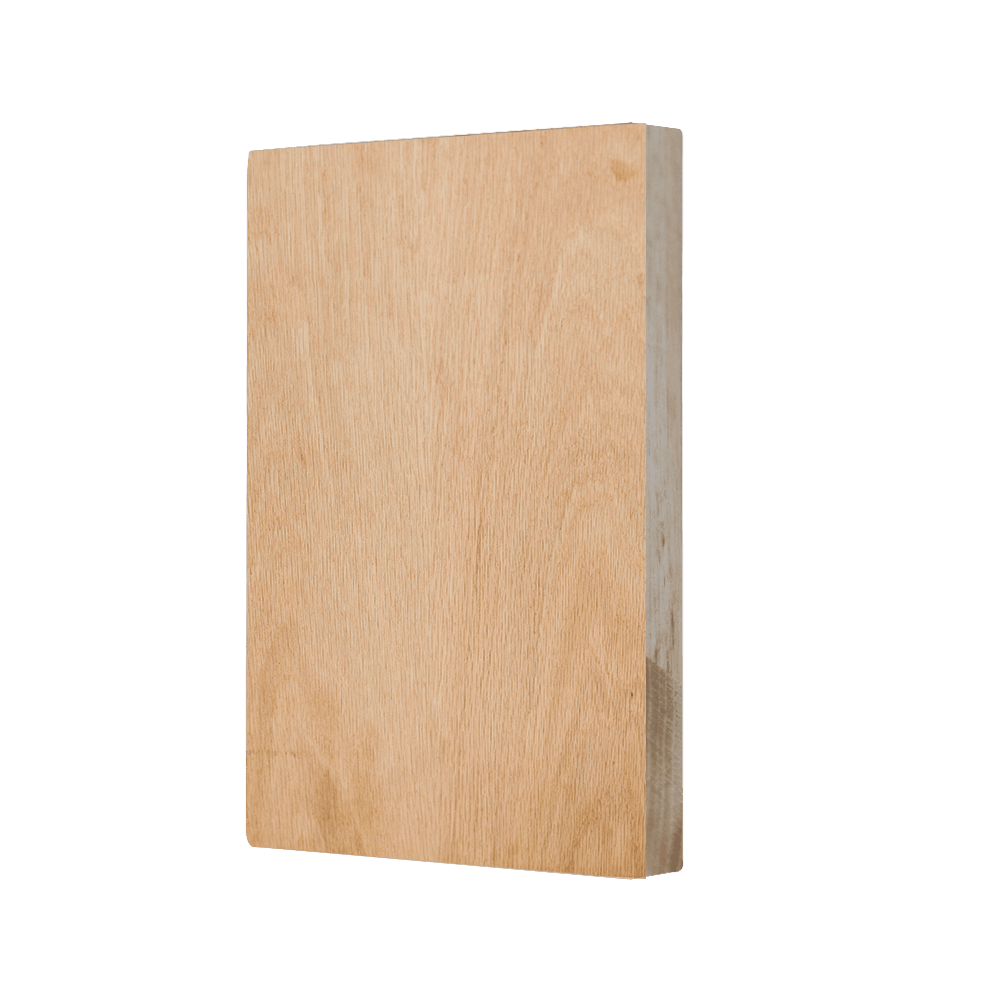
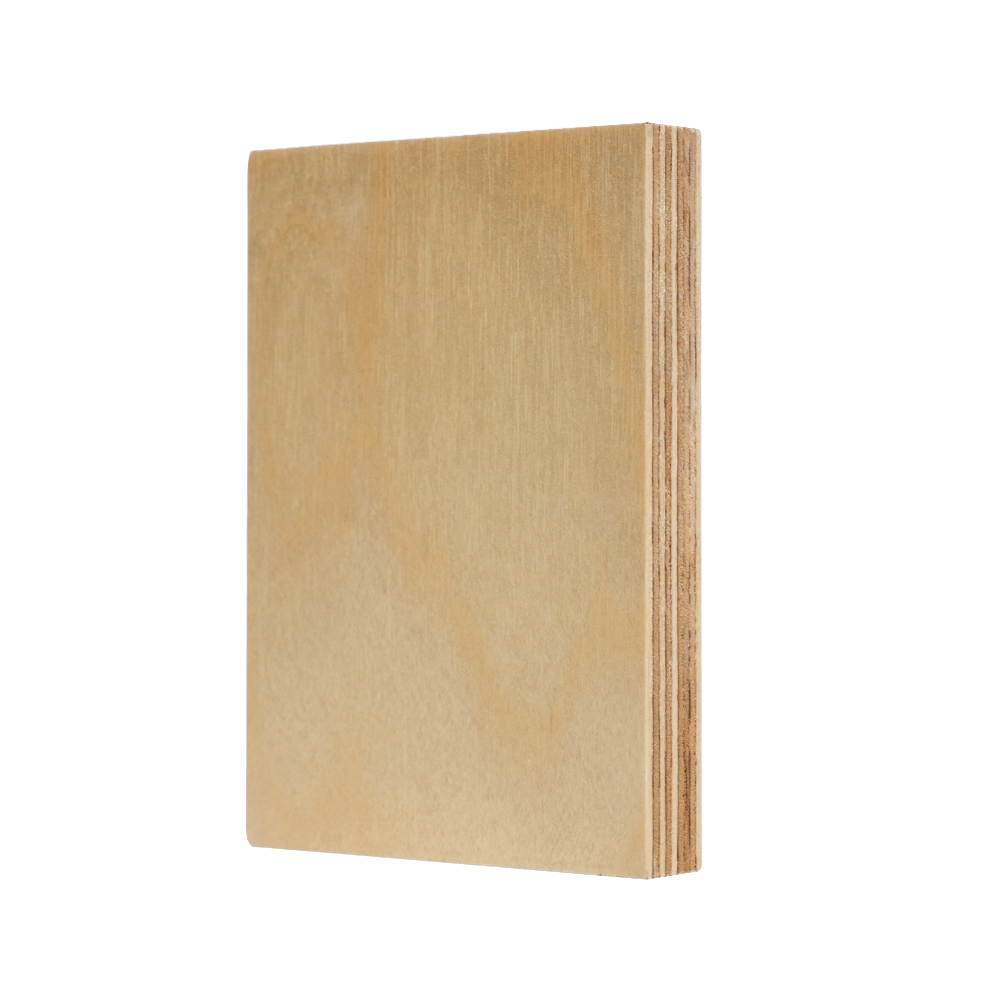 Premium Birch Plywood with Clean B/BB and S/BB SurfacesFor visible cabinetry and finishing, this top-grade birch plywood offers a clean sanded face with the same structural strength, ideal for furniture and interior work.View Product →
For cabinet faces and visible cabinetry, top-grade birch panels with B-BB or S-BB surfaces offer the same structural core as industrial birch plywood while providing a clean, sanded face for painting, staining, or clear finishing. For structural work where face appearance is secondary, the same panel construction is available in middle grades at a lower cost.
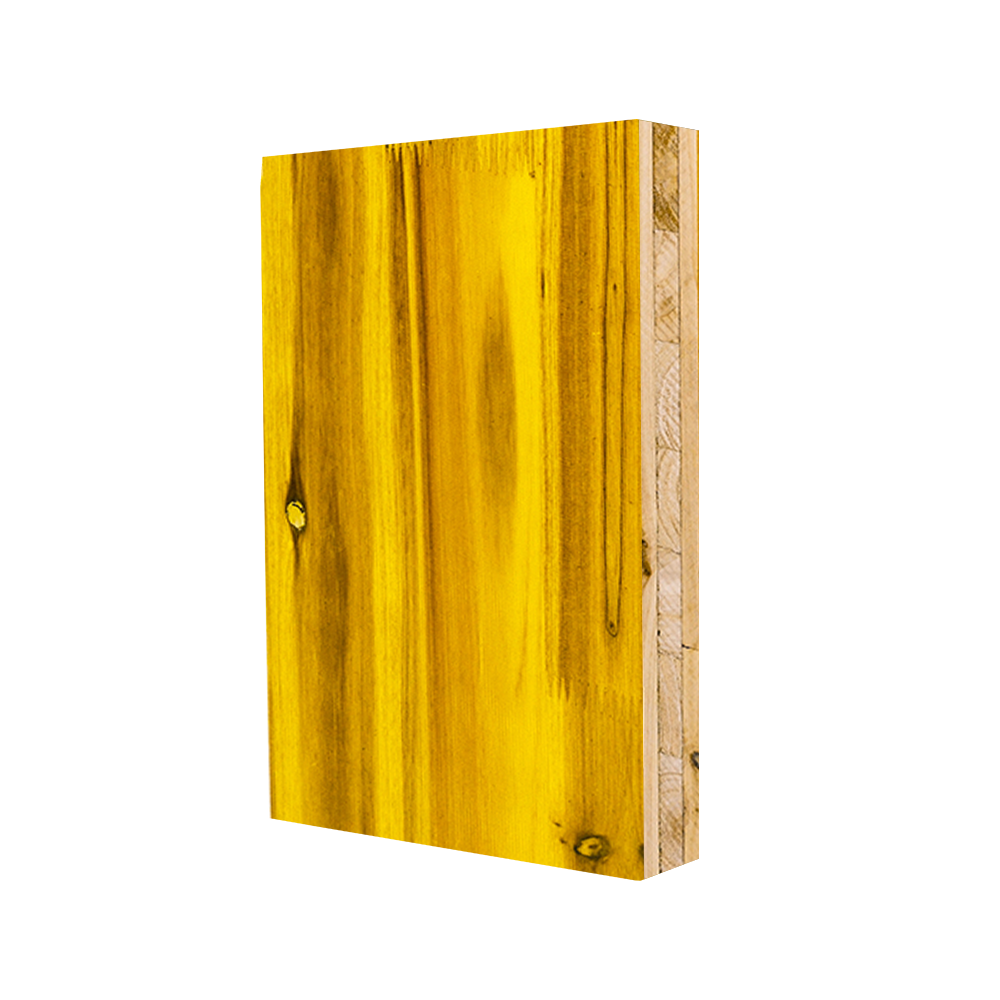
 Film-Faced Birch Plywood for Moisture and Outdoor ApplicationsThis overlay-protected birch plywood resists water and wear, making it the recommended choice for formwork, hoardings, and other demanding exposure conditions.View Product →
When the job involves moisture, concrete, or outdoor exposure, film-faced birch plywood pairs the same high-density core with a phenolic or melamine overlay that resists water absorption, chemical attack, and surface wear. That combination is the standard answer for formwork, hoardings, and outdoor temporary structures.
Birch wins on structure, but plywood selection is rarely about structure alone. Oak-faced panels remain the better choice in several situations:
Inspection begins with the datasheet, not with the panel face. The following checklist helps avoid the most common specification errors:
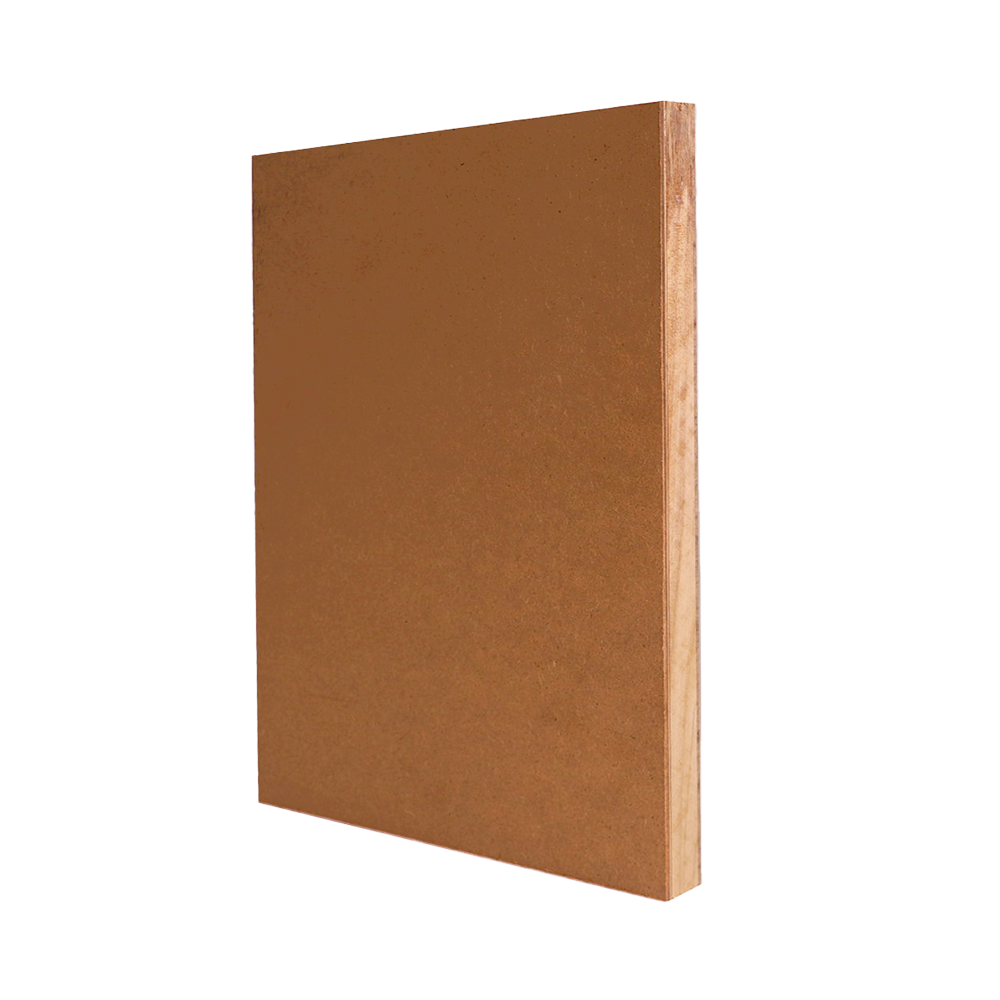
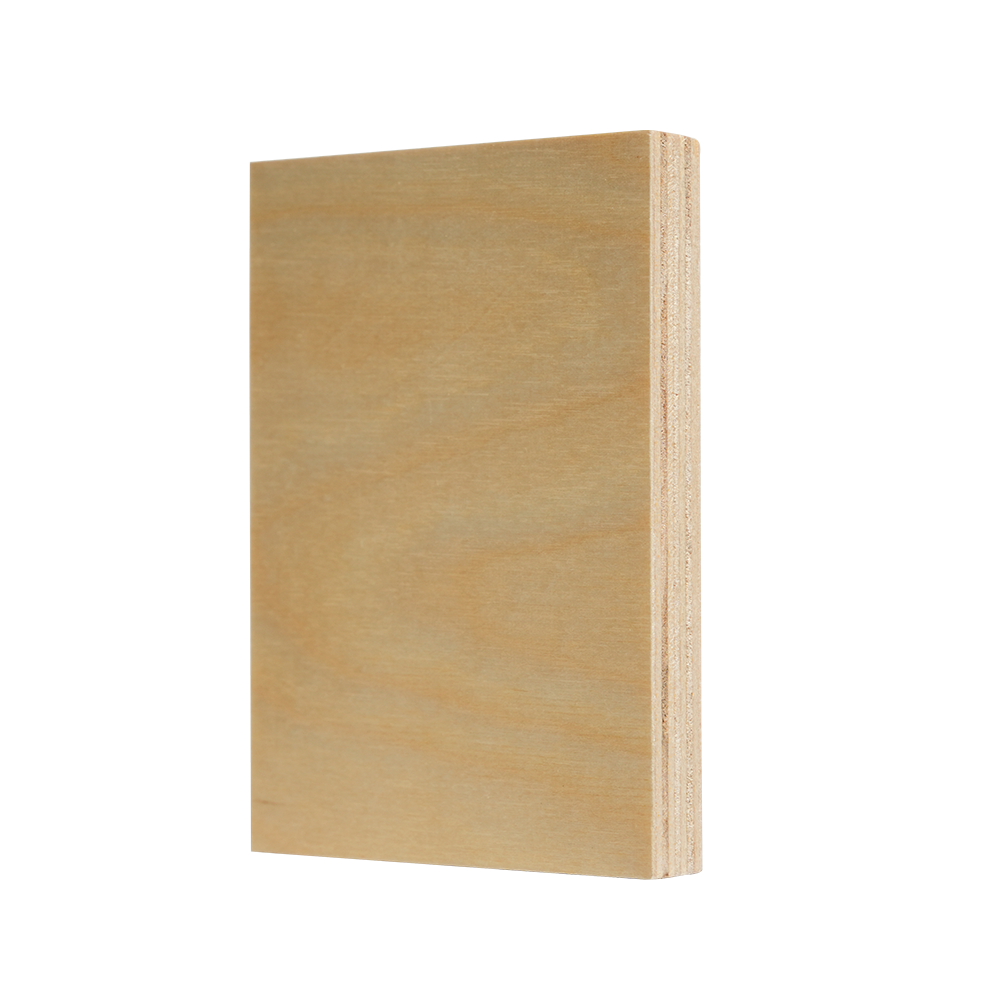 Cost-Effective Middle Grades Birch Plywood for Structural ProjectsWhen face appearance is secondary, these BB/BB and BB/CP panels provide reliable birch stability at lower cost, suitable for hidden structural applications and interior use.View Product →
One additional clarification prevents many costly mistakes: the difference between full-birch plywood and combi-birch plywood. Combi-birch panels use birch faces over a softer interior core, which lowers cost but also reduces mechanical strength. If the project depends on the strength values in this article, specify full-birch construction rather than a mixed core. A full-birch vs combi-birch professional analysis shows exactly how much the interior layers influence panel performance.
At equal thickness, full-birch plywood is stronger than oak-faced plywood with a softwood core. Full-birch panels typically reach 12,000 N/mm² in modulus of elasticity and 75 N/mm² in modulus of rupture at 18 mm thickness, while oak-faced softwood-core panels reach around 6,800 N/mm² and 42 N/mm². Solid oak lumber is comparable to solid birch, but the engineered panel comparison depends on the core, not the face species.
It depends on the core. Oak-faced plywood with a birch or other hardwood core is strong enough for cabinet carcasses and doors. Oak-faced poplar- or pine-core panels are suitable for shelving with moderate load, but wide spans may sag and hinge screws may lose grip over time. For cabinet sides supporting heavy drawers, use 18 mm panels with a hardwood core or switch to full-birch plywood.
Solid white oak has a slightly higher bending strength, typically around 100 N/mm², and stiffness near 12,300 N/mm². Birch plywood at 18 mm reaches about 75 N/mm² and 12,000 N/mm². However, birch plywood offers uniform strength in both panel directions, higher fastener retention at panel edges, dimensional stability across humidity changes, and a much lower weight per square metre than the equivalent solid board. For most panel applications, the comparison is not favourable to solid oak.
Birch plywood is manufactured with hardwood birch veneers in every layer, which increases material cost and processing difficulty. Oak-faced panels use a single thin oak veneer over cheaper softwood or fibreboard. The number of plies, drying requirements, and pressing cycles for full-birch panels are also higher. Price differences narrow when oak-faced panels are built on hardwood cores.
Availability for outdoor use depends on the adhesive, not the species. Birch plywood bonded with WBP or phenolic resin, or supplied with film-faced surfaces, is suitable for exterior, wet, and high-humidity conditions. Birch plywood bonded with interior adhesive is not. All exterior structural birch panels should be marked with moisture-resistant adhesive classes and should include sealed edges to prevent water ingress.
For a 700 to 1,000 mm unsupported shelf span carrying books or hardware, use 18 mm full-birch plywood with supports at both ends. For a workbench, 27 to 40 mm birch plywood is preferable; if weight is a concern, a 20 mm or 25 mm birch panel on a rigid steel or wood frame gives good performance. Always verify the MOE of the actual panel because edge support and framing dramatically change real-world deflection.
When the panel will carry load, resist impact, hold hardware, or withstand repeated handling, specify full-birch plywood and verify that the core is birch from the datasheet. When the panel exists primarily to show an oak grain, an oak-faced panel is acceptable — but the strength of solid oak does not transfer to a panel with a softwood core. Check the core, count the plies, confirm the adhesive class, and request test values before ordering. That sequence eliminates the most common causes of sagging shelves, failing hinges, and premature formwork failure.
related products


Copyright © Tianma Lvjian Group Co., Ltd. Rights Reserved.
Wholesale Construction Plywood Manufacturers Privacy
 English
 中文简体